Identifying John Singer Sargent Painting Locations: No. 1478

This post is one of a series of blog posts covering my independent research on previously unidentified locations depicted in John Singer Sargent pieces. Pieces are identified using their Yale University Press ID numbers, as published in the series John Singer Sargent: The Complete Paintings, co-authored by Richard Ormond and Elaine Kilmurray. All findings are my own, represent my own opinions, and were reached using a combination of my own intuition & various publicly available tools, such as Google Maps & Google Street View.

This post covers the location depicted in John Singer Sargent’s piece titled “Majorca” (Yale 1478), a beautiful watercolor depicting a rugged coastline hugging a sea & sky of blue.

Here is the piece in question:
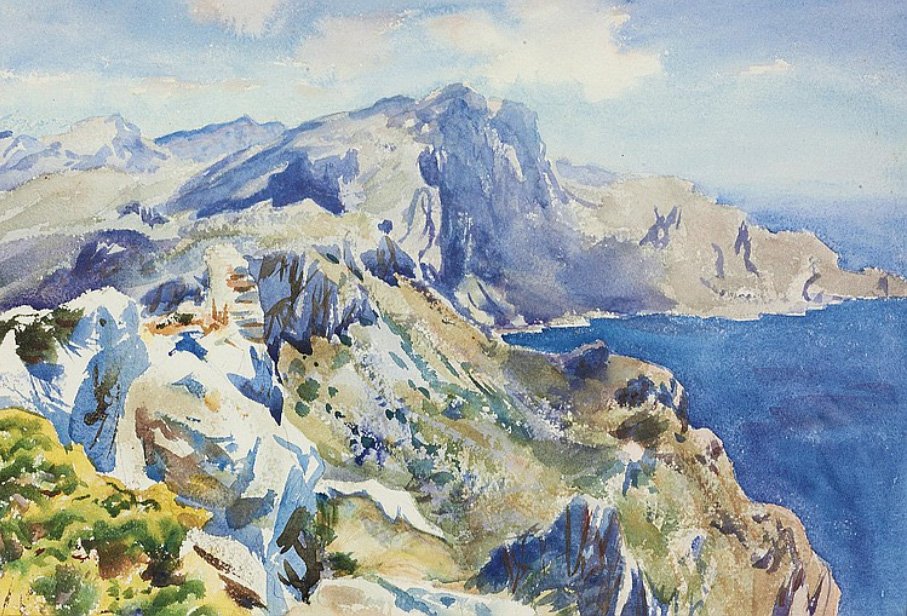
I do believe No. 1478 "Majorca" is correctly identified as a Mallorca painting in the catalogue raisonné; however, I believe the exact location is much further northeast from Deià - that is, the northeasternmost location pinpointed on the map of Sargent's painting locations in Mallorca ("Sargent and Spain", pp.10-11).  I believe this painting was created at, or very near, to Castell del Rei, in the much more remote municipality of Pollença.  Below is a visual summary of my findings:
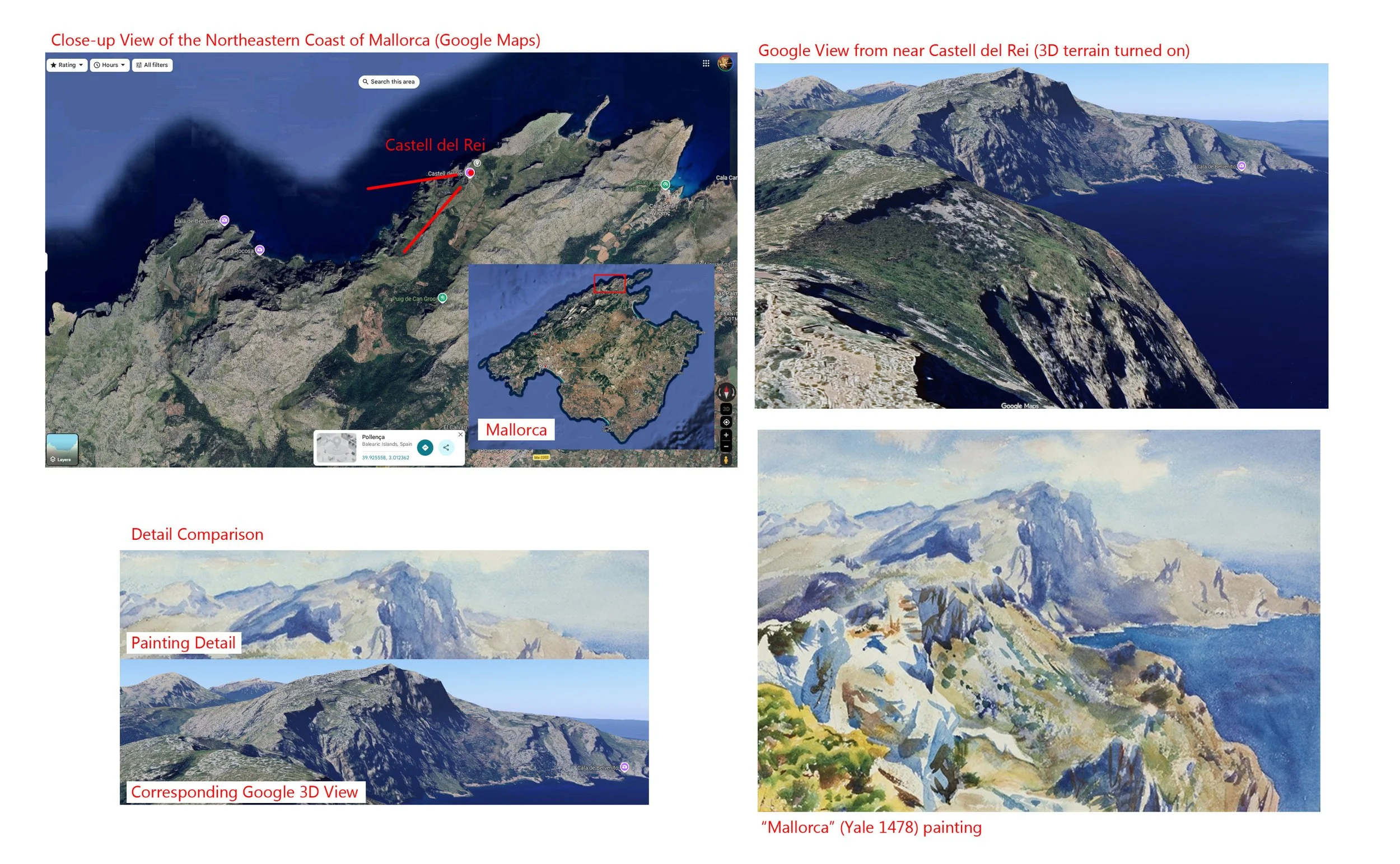
I have never travelled to Mallorca, let alone Castell del Rei, so I had to use my understanding of topography to guide me towards the correct location.  There is quite obviously a cliff-like feature at the center background of the painting that dives directly into the ocean, in the middle of what looks like a large curvature in the coastline (not quite a bay), with a rugged peninsula jutting out in the background.  I was unable to find any features further west near Valldemossa or Deià that match, but I came across this exact arrangement at Castell del Rei, further east. 

As soon as I rotated the view in Google Maps (with 3D terrain on), the image of Sargent's composition popped out, clear as day.  I highlighted the mountain skyline comparison (lower left of my compilation image above), where the features (and even the lighting!), are a very solid match!  Was it known that Sargent might have travelled this far east, to this relatively remote location?  Anyway, I discovered it is quite the scenic area, so I'm not surprised.

Date of identification: c. 4/21/2026, reported to the authors on 4/25/2026
Identifying John Singer Sargent Painting Locations: No. 1690

This post is one of a series of blog posts covering my independent research on previously unidentified locations depicted in John Singer Sargent pieces. Pieces are identified using their Yale University Press ID numbers, as published in the series John Singer Sargent: The Complete Paintings, co-authored by Richard Ormond and Elaine Kilmurray. All findings are my own, represent my own opinions, and were reached using a combination of my own intuition & various publicly available tools, such as Google Maps & Google Street View.

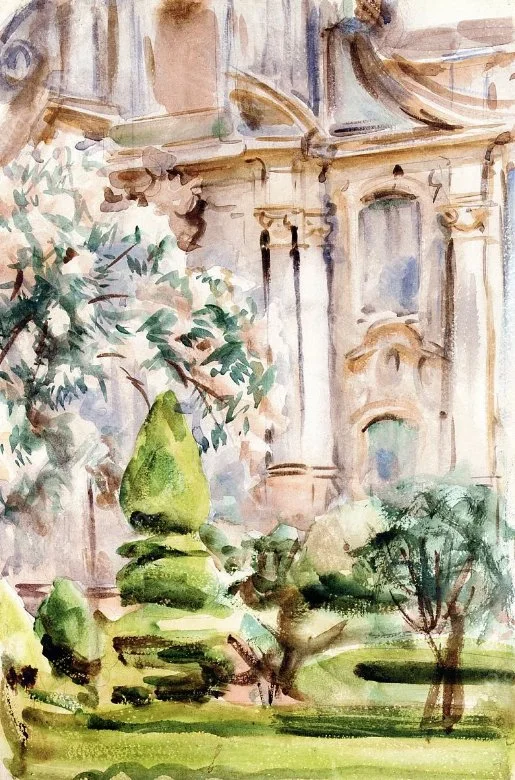
This post covers the location depicted in John Singer Sargent’s piece titled “A Palace and Gardens, Spain” (Yale 1690), a beautiful watercolor featuring a majestic facade, with lush vegetation in the foreground.

Here is the piece in question:

Tackling No. 1690 was a different beast from my earlier Venice identifications.  The previous endeavors were all located in a confined, rigid, perpetually preserved city, shortening the 100+ years between us considerably.  However, once I decided to pursue an identification in Spain, it dawned on me that not only did I have to search an entire region or country's tally of leads, but nestled between me and the piece was the possibility that the Spanish Civil War had transformed the built landscape considerably.

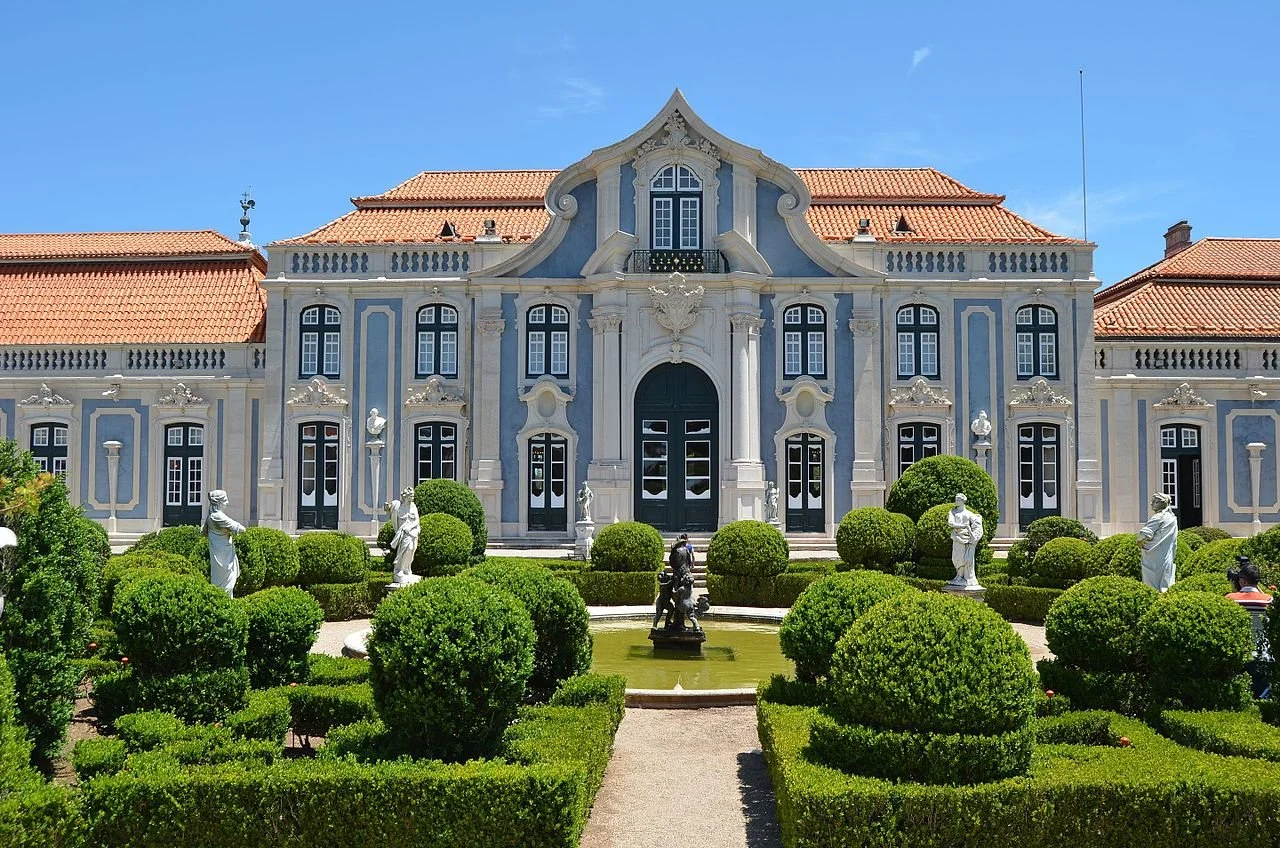
Reading the description in the catalogue raisonné carefully, I also concluded that we were relying on the accuracy of information from an auction listing in 1925, that likely did not come from JSS himself.  It's not clear to me who titled the piece, but indeed, the title "A Palace and Gardens, Spain" proved to be the biggest red herring, and elongated my search by many days, likely.  It is my opinion that No. 1690 depicts a scene showing the ballroom wing of the Palace of Queluz, Portugal.  Pictured below:

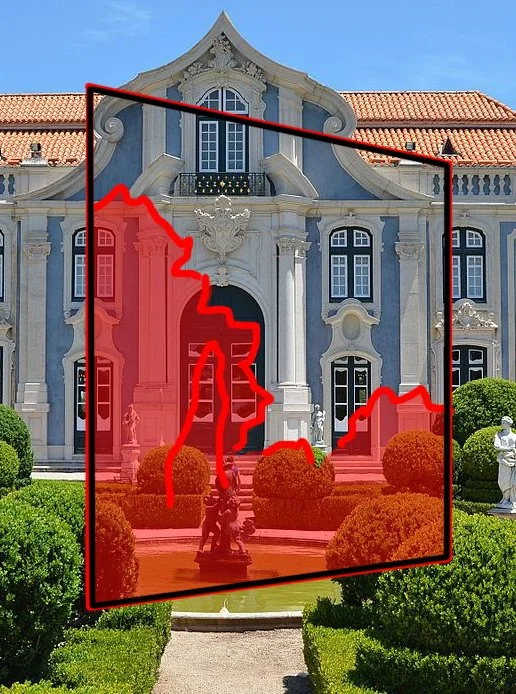
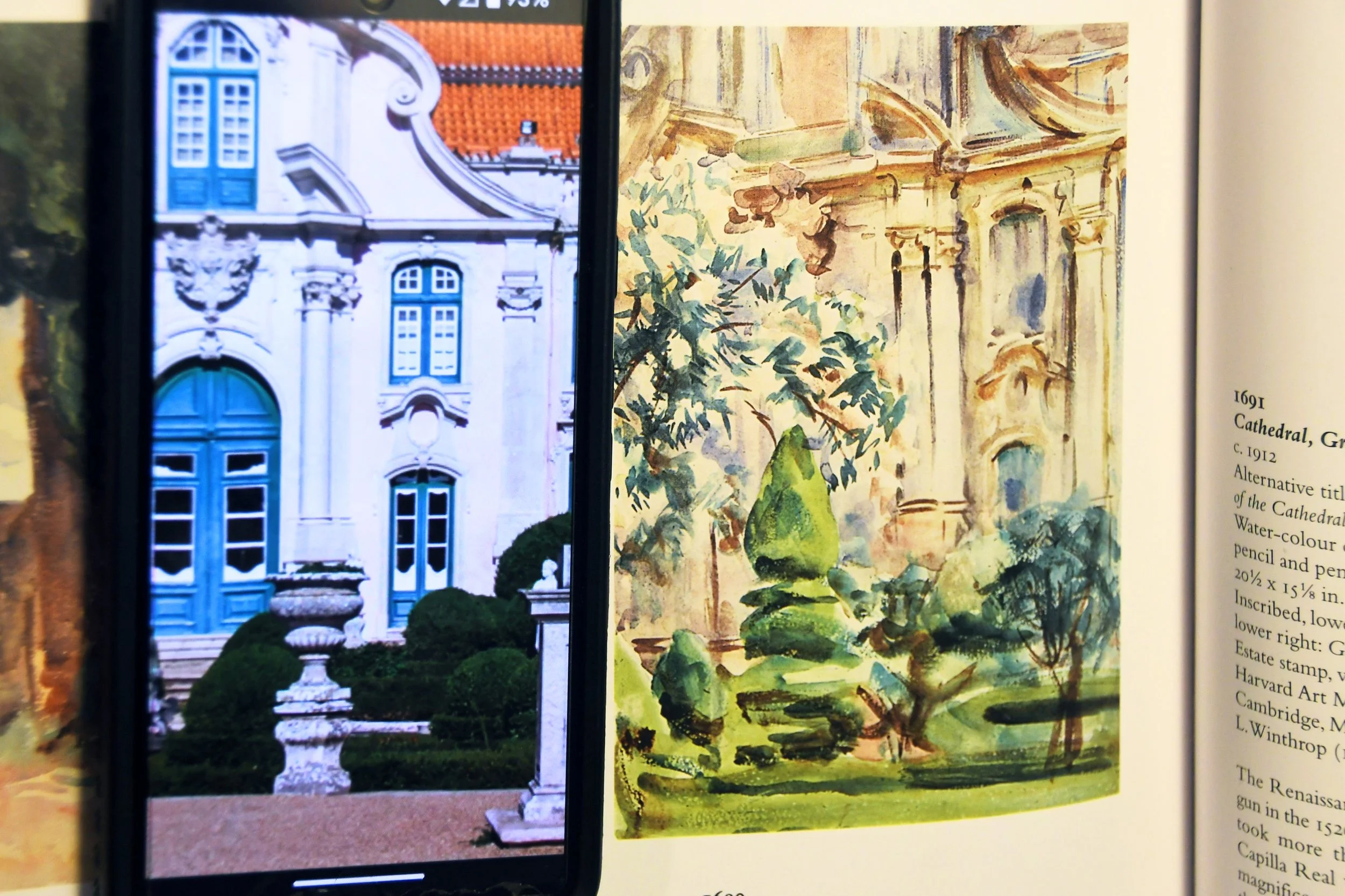
There are several unique features of the building appearing in the background of the scene that offer the only realistic clues in identifying the piece - the double Corinthian columns with a broken pediment above at the center of the piece, the upturned arch at the upper right hand of the piece, the thumbprint-shaped ornamentation between the 2 stories of windows below that, and what appears to be a sculptural coat-of-arms just behind the large tree, centered on the broken pediment.  Here's an overlay of the image above with the approximate extents of the Sargent piece:

And perhaps more helpful, here's a side-by-side comparison of the piece and another image I found online, where the architectural features and proportions are a clear match:

I will spare you the details of how I arrived in Portugal during my search, but the match is undeniable to me. I was also unaware that JSS had visited Portugal, but in another book ("Sargent & Spain") the timelines towards the back of the book proved quite valuable.  In it I read that he visited Spain and Italy via Portugal in 1903.  I wonder if this piece was painted at that time, but I do not know enough about his travels (e.g. how many times he transited Portugal) and about the history of this piece to make any assertion there.  It was curious, though, that this piece did not appear in that book about Spain.

Date of identification: c. 5/22/2024, reported to the authors on 5/28/2024

Identifying John Singer Sargent Painting Locations: No. 1095

This post is one of a series of blog posts covering my independent research on previously unidentified locations depicted in John Singer Sargent pieces. Pieces are identified using their Yale University Press ID numbers, as published in the series John Singer Sargent: The Complete Paintings, co-authored by Richard Ormond and Elaine Kilmurray. All findings are my own, represent my own opinions, and were reached using a combination of my own intuition & various publicly available tools, such as Google Maps & Google Street View.

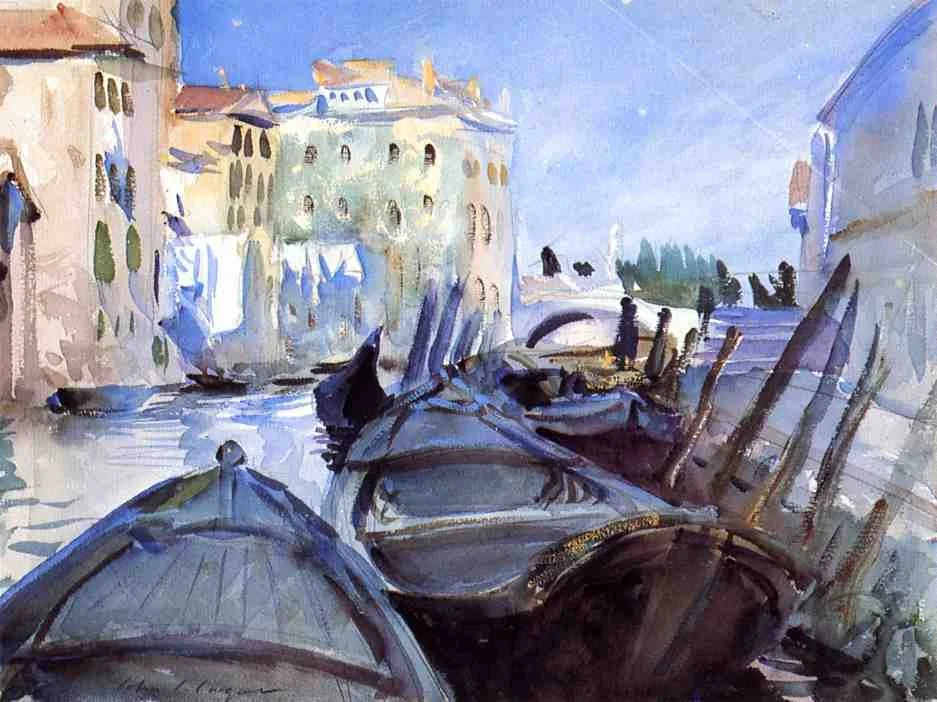
This post covers the location depicted in John Singer Sargent’s piece titled “Venetian Canal Scene” (Yale 1095), a beautiful watercolor showing a scene of a wide canal, with boats in shade in the foreground.

Here is the piece in question:

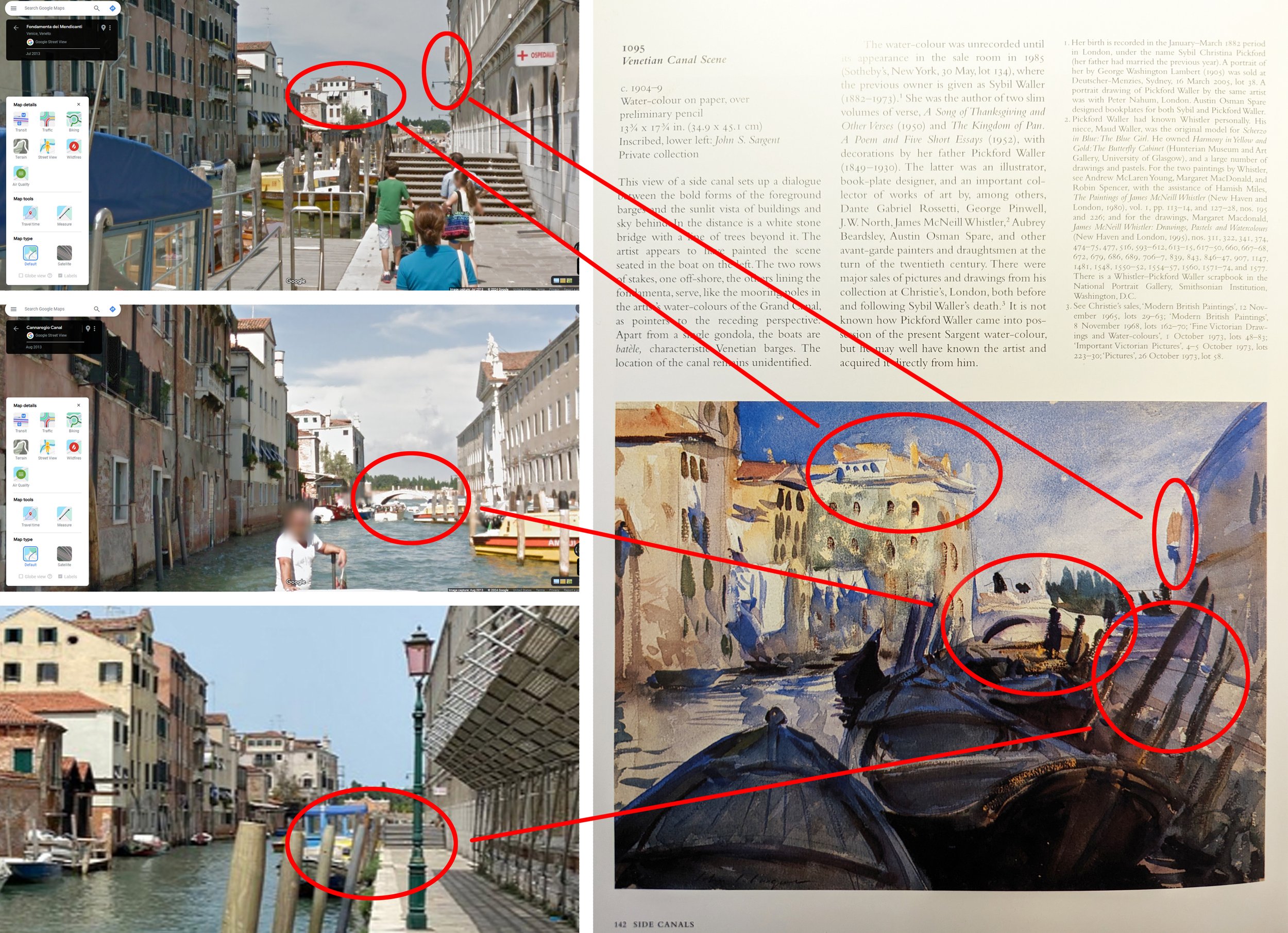
This one took me for a wild ride.  Several aspects of the painting were glaring clues - for example, the canal is very wide for a side canal, there appears to be two bridges in the scene (one white bridge in profile in the background and another bridge just to its right with only the steps visible), and finally, the expanse of greenery in the far background - a rare sight in Venice!  These clues should have made for an easy hunt, but it took me a bit of time to clarify what each clue meant.  In the end, I think I have succeeded.  The painting was painted in the Rio dei Mendicanti, alongside the Fondamenta dei Mendicanti, looking north.

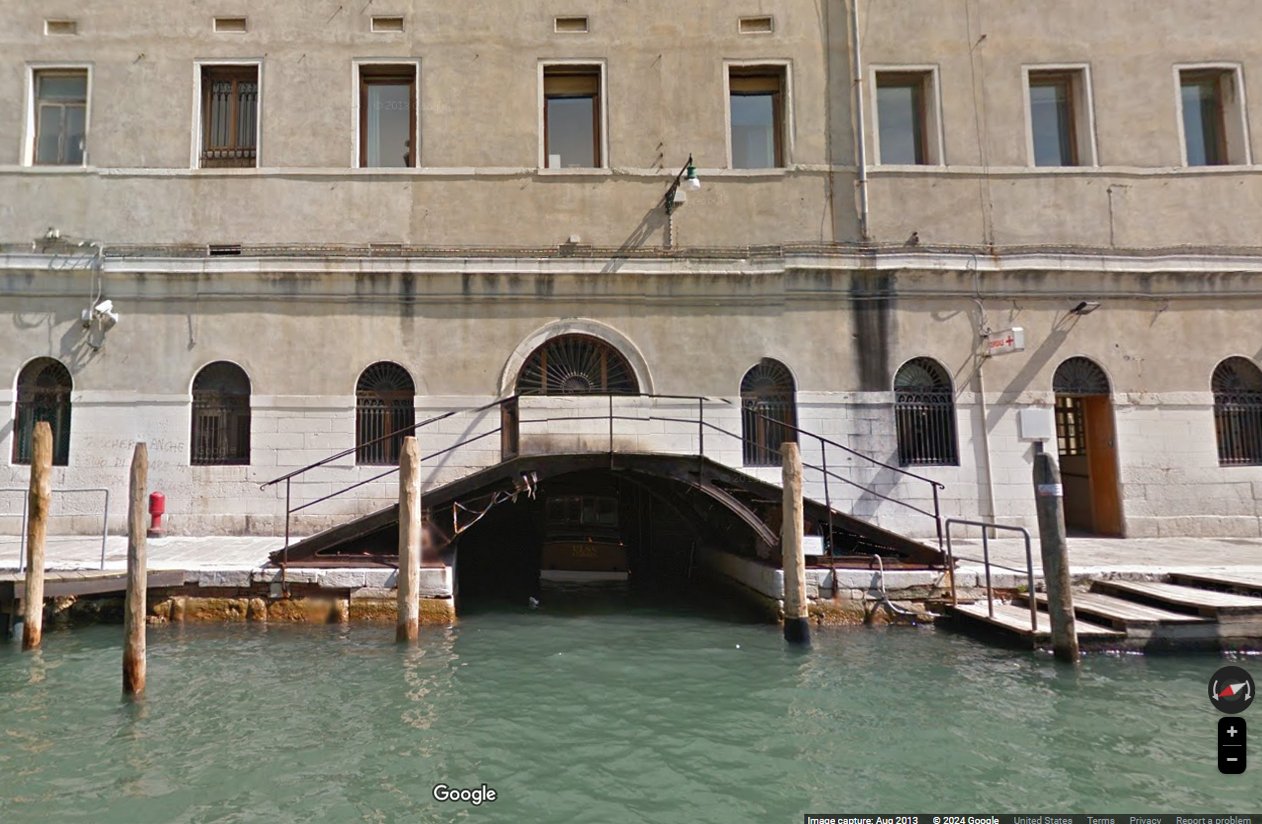
Here’s a Google Street view of the Fondamenta and the second "bridge" from the scene, but looking at it in profile.:

And here are various other Google Street views, with corresponding elements in the scene highlighted:

First off, the greenery is that of the San Michele Cemetery separated from the main islands of Venice in the lagoon.  There are plenty of trees in the cemetery, and the view down Rio dei Mendicanti looking north does indeed offer a view of the cemetery (the bridge, by the way, is Ponte dei Mendicanti).  Second, the Rio dei Mendicanti is, as suggested, a "wide" side canal.  And third, the second "bridge" we are seeing (the one with only steps visible), does not actually bridge over an intersecting canal, but rather a boat entrance to the building to the east.   

Date of identification: c. 1/31/2024, reported to the authors on 2/1/2024

Identifying John Singer Sargent Painting Locations: No. 1084

This post is one of a series of blog posts covering my independent research on previously unidentified locations depicted in John Singer Sargent pieces. Pieces are identified using their Yale University Press ID numbers, as published in the series John Singer Sargent: The Complete Paintings, co-authored by Richard Ormond and Elaine Kilmurray. All findings are my own, represent my own opinions, and were reached using a combination of my own intuition & various publicly available tools, such as Google Maps & Google Street View.

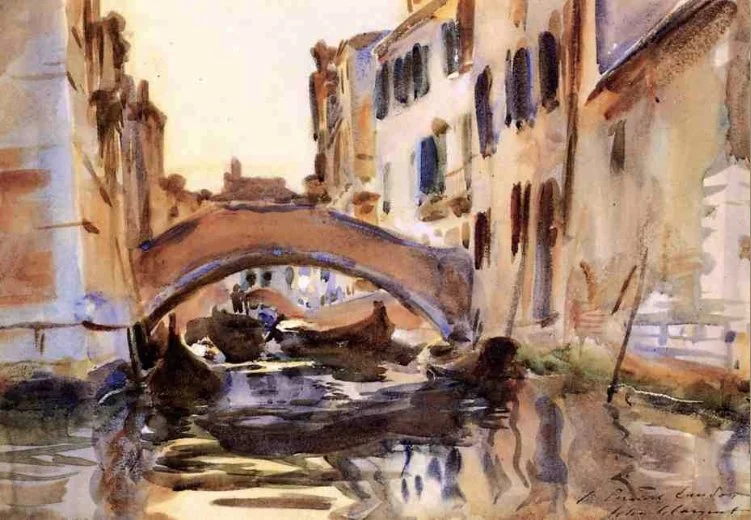
This post covers the location depicted in John Singer Sargent’s piece titled “Venetian Canal” (Yale 1084), a beautiful watercolor with a view of a bridge from a canal, with warm air filling the scene.

Here is the piece in question:

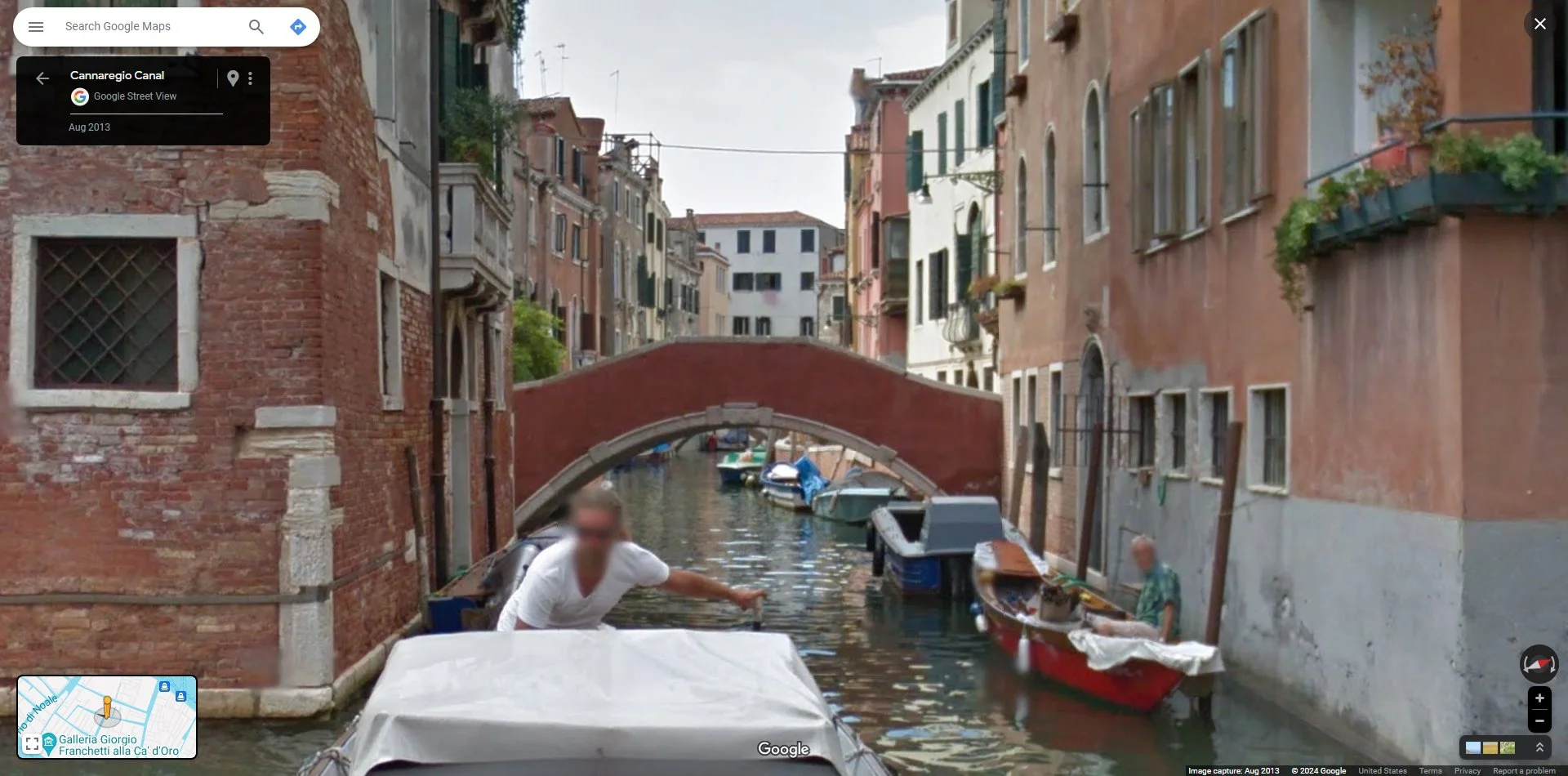
This one was difficult to identify due to the buildings being largely generic Venetian style buildings.  The biggest clue for me in this one is the bridge itself.  While there are hundreds of bridges in Venice, they are surprisingly quite varied in shape, size, construction materials, and details, and it can be helpful to narrow down the possibilities by studying these aspects.  Looking through an inventory of photos of bridges of Venice helped me nail down this bridge to be Ponte Sant'Andrea.  The piece was painted near the intersection of Rio di Sant'Andrea and Rio Ca' Dolce, looking west.  

There are other clues as well.  Looking closely, one can see the corners of two opposing buildings in the foreground - at the far left and far right of the painting.  Two corners in view suggests at least a three-point intersection of canals, rather than just, say, a bend in a canal.  Additionally, there seems to be a second bridge in the background, along with a fondamenta to the right - both suggested by faded reddish paint strokes.  

The building on the right in the foreground looks completely different between photo and painting, but it occurred to me that the building in the photo is exceptionally modern, and its construction / renovation likely dates to after the painting was created. Finally, looking through the catalog raisonné, I see that Sargent painted this bridge before (Yale 1097), but from the opposite direction, which is promising, since he is known to have painted the same subject matter more than once, and it shows that he did visit this area of Venice.  .  

Date of identification: c. 1/31/2024, reported to the authors on 2/1/2024

Identifying John Singer Sargent Painting Locations: No. 1082

This post is one of a series of blog posts covering my independent research on previously unidentified locations depicted in John Singer Sargent pieces. Pieces are identified using their Yale University Press ID numbers, as published in the series John Singer Sargent: The Complete Paintings, co-authored by Richard Ormond and Elaine Kilmurray. All findings are my own, represent my own opinions, and were reached using a combination of my own intuition & various publicly available tools, such as Google Maps & Google Street View.

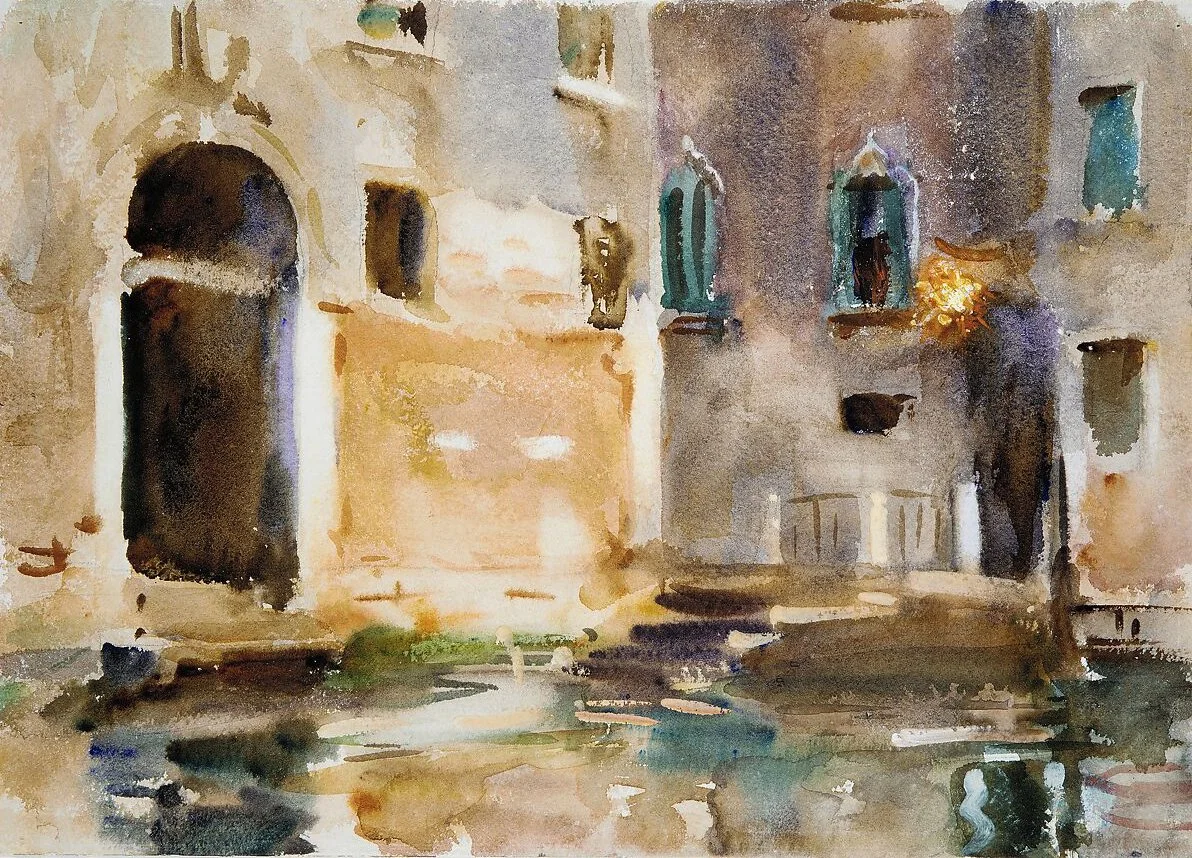
This post covers the location depicted in John Singer Sargent’s piece titled “Venice” (Yale 1082), a beautiful watercolor featuring a mysterious “corner” of Venice

Here is the piece in question:

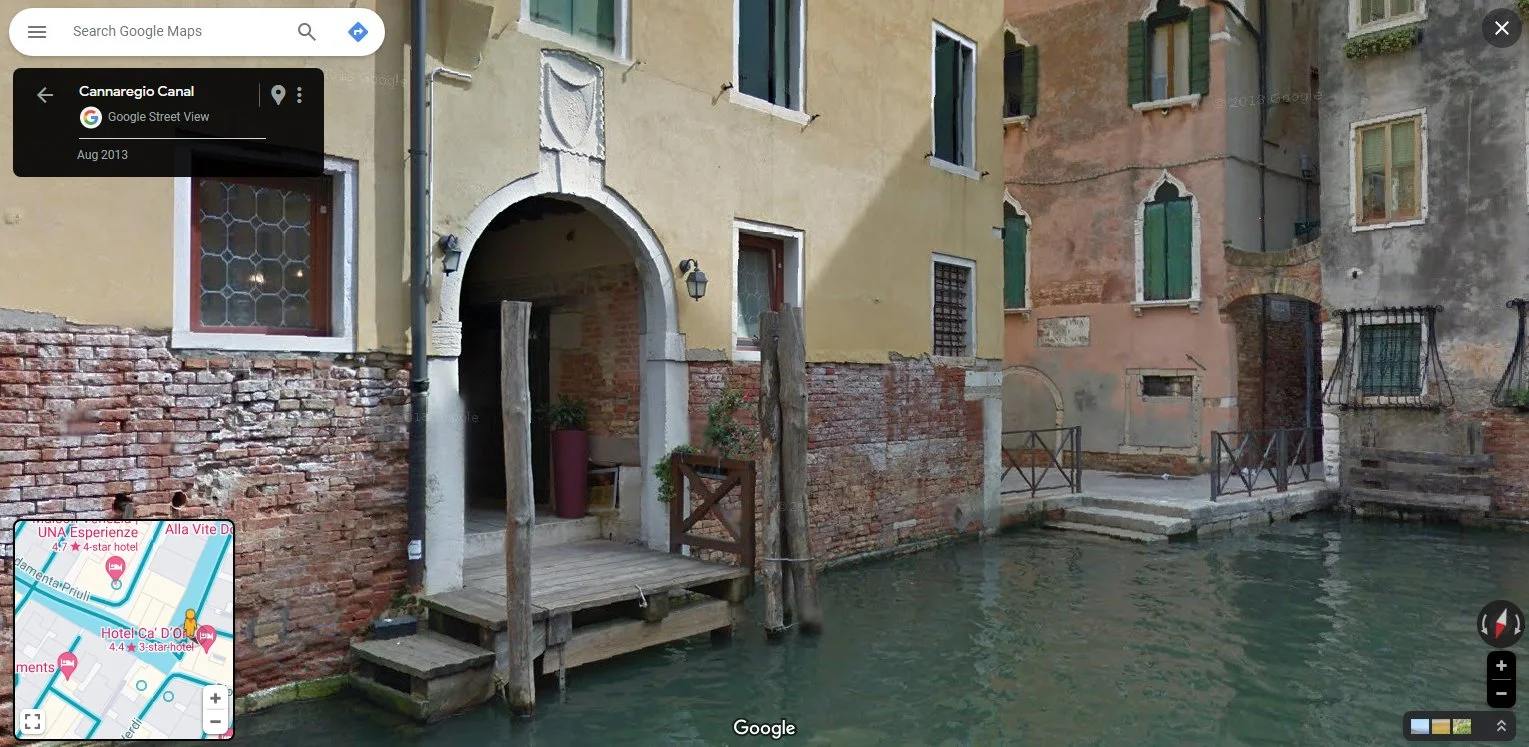
In my opinion, the painting was created at the L-shaped intersection of Rio de Santa Sofia and Rio Ca' Dolce in the Cannaregio sestiere, from the Rio Ca' Dolce looking south. Here's an approximate Google Street View:

The architectural features and rhythms are unmistakable, down to the architectural features above the arched opening to the left and the small window near street level in the central building that seems to have been partially blocked up (the very dark horizontal rectangle above the steps).  Once again, the apparently unmatching colors of paint can be ignored. 

The presence of a narrow space separating the middle building from that on the left is noticeable, but I was doubtful the gap was due to the presence of a canal - the small landing with steps in the foreground of the painting appears to lead directly into the dark arched opening to its right, obstructing any access to water beyond, so I determined an alleyway or plaza should be the feature creating such a gap. 

Using this information, as well as the perpendicular arrangement of the buildings, I assumed either the scene depicted the dead end of a canal (a rare event in Venice), or more likely, that a canal extended to the right, off the page, creating a right angle bend, as seen on the map inset.

Date of identification: 1/16/2024, reported to the authors on 1/21/2024

Identifying John Singer Sargent Painting Locations: No. 1081

This post is one of a series of blog posts covering my independent research on previously unidentified locations depicted in John Singer Sargent pieces. Pieces are identified using their Yale University Press ID numbers, as published in the series John Singer Sargent: The Complete Paintings, co-authored by Richard Ormond and Elaine Kilmurray. All findings are my own, represent my own opinions, and were reached using a combination of my own intuition & various publicly available tools, such as Google Maps & Google Street View.

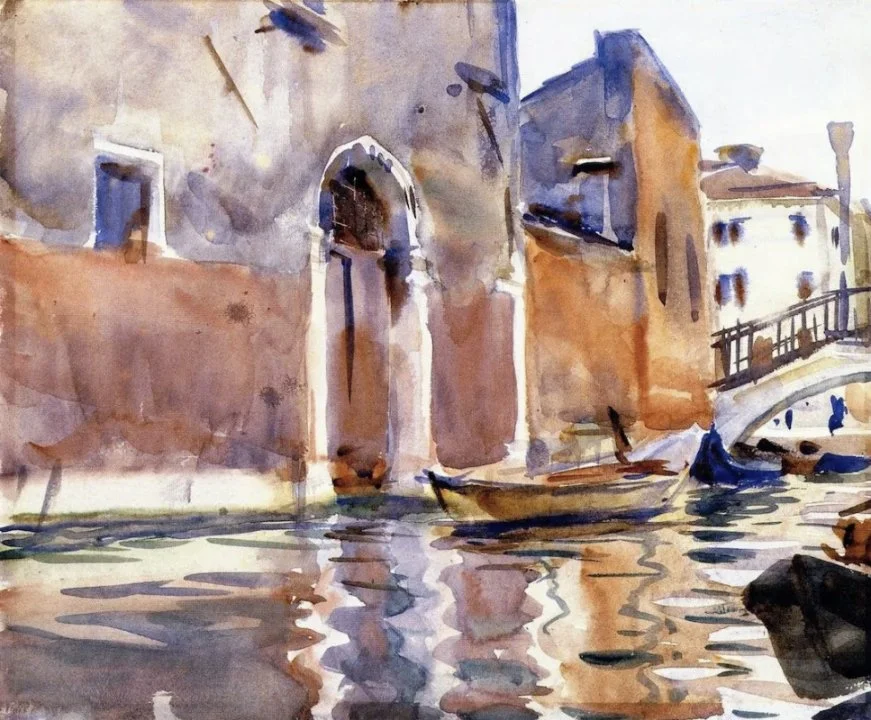
This post covers the location depicted in John Singer Sargent’s piece titled “Side Canal, Venice” (Yale 1081), a beautiful watercolor with a marching rhythm of quintessential Venice features along a side canal in Venice.

Here is the piece in question:

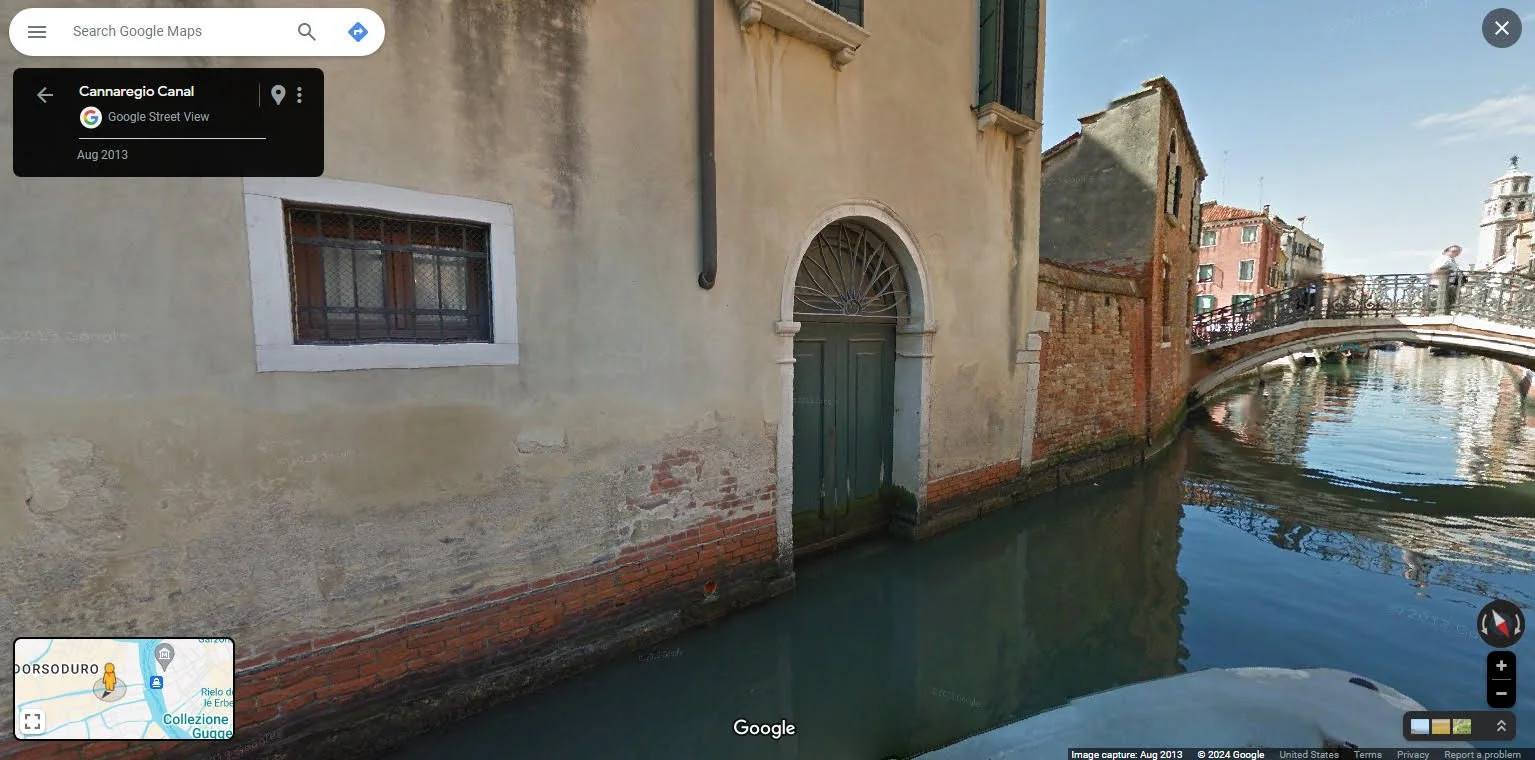
In my opinion, the painting was created on the Rio de San Barnaba, just east of the Campo San Barnaba, looking west.  Here is a Google Street View of the approximate location:

Obviously the viewpoint in the painting is lower than that of the Google Street View, and is not as "wide angle".  While some of the buildings have since been re-painted (the building in the foreground seems to have received a new white color and had paint removed from the base, and the one behind the bridge perhaps turned pink from white), the rhythm of the buildings, openings (doors & windows), bridge, and campo behind the bridge is unmistakable.  

It appears the large chimney stack in the background has since been removed, or cut back, and is now a shorter chimney that does not protrude into the skyline. 

These minor modifications - repainting, cutting back chimneys - seem to have been common in Venice throughout its history, even if the buildings themselves remain quite well preserved.

Date of identification: c. 1/15/2024, reported to the authors on 1/17/2024

Wrapping Up a Year to Remember: 2020

There is little need for me to remind the world here and now why this past year has been one for the history books. The ropes of society have frayed into countless individual strands of lonesome realities, pointing in different directions towards the ethers of anxiety, grief, uncertainty, regret, worry, guilt, and anger about the future of our livelihoods, families, country, civilization. But for future generations, there is much to learn from written recollections of what has transpired in the past 12 months, where the foundations of our society have been hacked at from multiple fronts, at times invisibly and inexplicably, with one shocking setback after another, by the day. In equal measures, deeply ingrained values and freedoms, formerly the pride of our ignorance, continue to be stricken from the soul of our wheat. For better or worse, time will, from this strange string of events that calls itself a calendar year, distill and harden the lessons our descendants are to learn, the conclusions to be drawn, the messages to be blared. It is difficult to sift through daily tragedy and emerge with some forward hope, but perhaps it is there, even now. I implore my fellow beings to turn to art, and find some hope and peace.

It's hard for me to consider another year in which I've turned more heavily to my artwork for sanity, solace, and structure than this year. My work in architecture is my anchor, but making art was my nights out, my weekends, my vacations, my escapes, my sustenance, my support, and hopefully a bit of support for others. Thank you to all the fine musicians, restaurant patrons, park-goers, and even some family, who've allowed me to work them into my art. While this year has dug its own little corner into my soul, let's turn a page on this one.

Here are 25 pastel pieces from this year, divided into 5 chronological acts (ink, pencil pieces, and miniature studies not shown).

Stay safe, stay strong, stay connected, live and flourish.

Snippets: 1. Behind a Spotlight in a Harlem Music Cafe, 2. In a Spell, 3. A Packed Bar in BedStuy, 4. Uplight and an Upright, 5. Shadows of the Past and Present

Snippets: 1. Behind a Spotlight in a Harlem Music Cafe, 2. In a Spell, 3. A Packed Bar in BedStuy, 4. Uplight and an Upright, 5. Shadows of the Past and Present

Snippets: 6. All Things Aligned, 7. Somewhere Between Paris and Brooklyn, 8. A Violinist and a Piece of Sky, 9. Walls Within, 10. Two-Wall Blues

Snippets: 6. All Things Aligned, 7. Somewhere Between Paris and Brooklyn, 8. A Violinist and a Piece of Sky, 9. Walls Within, 10. Two-Wall Blues

Snippets: 11. Love Surrounds, 12. Adjustments, 13. Turning Heads in Crown Heights, 14. Park Bench Jazz, Before the Rain, 15. Flashbacks in a Garden Evening

Snippets: 11. Love Surrounds, 12. Adjustments, 13. Turning Heads in Crown Heights, 14. Park Bench Jazz, Before the Rain, 15. Flashbacks in a Garden Evening

Snippets: 16. A Summer Night at Cobble Hill Park, 17. Ages Pass at a Sidewalk Brunch, 18. Illuminated Openings, 19. Second Sunday Back at the Saloon, 20. A Jazz Band and a Pickup Truck

Snippets: 16. A Summer Night at Cobble Hill Park, 17. Ages Pass at a Sidewalk Brunch, 18. Illuminated Openings, 19. Second Sunday Back at the Saloon, 20. A Jazz Band and a Pickup Truck

Snippets: 21. In the Basement, Among the Stars, 22. The Velvet Bridge, 23. Sunset off the Rio de l’Alboro, 24. Escargot on Union Street, 25. Sources of Warmth

Snippets: 21. In the Basement, Among the Stars, 22. The Velvet Bridge, 23. Sunset off the Rio de l’Alboro, 24. Escargot on Union Street, 25. Sources of Warmth

Fifty NYC Pastel Pieces Completed!

I have always been a fan of numerical milestones, so it is with my great pride and pleasure to share with you the news that I’ve just completed my 50th New York City pastel study. Here's a few interesting facts about these first 50:

1) 94% of these paintings were created at night
2) Over 170 of you fine New York residents / visitors are captured
3) 19 unique venues appear in my pieces
4) It's taken me just over 30 months to get this far
5) The most separate appearances by the same individual: 4
6) The number of pieces that feature a single person: 6
7) The number of pieces sold / gifted / reserved for sale: 13. Hey, that means 37 are still available! Inquire within.

Collage of the first 49 pieces

Collage of the first 49 pieces

And #50 - featuring the Eyal Vilner Big Band at Swing46

And #50 - featuring the Eyal Vilner Big Band at Swing46

Looking forward to the next 50! I’ll see you when we get there.

First Show in the Books

Last night's show was a huge success - a fine way to step into the public domain, albeit in low-key, hidden speakeasy fashion.  With so many people to thank, I may as well just thank everyone, but alas some people deserve unique recognition: first and foremost my wife, Emily, who continually provides a nurturing environment in which I can create; the ownership and staff at Le Boudoir, whose receptivity to my artistic processes and products was without reservation; the musicians and subjects of the pieces, whose auditory offerings entrench themselves deeply into my drawings; and finally my family and friends, who made it their duty to ensure success with a slice of fun. 

Ten pieces made it on display, with a handful even earning the honor of the "red dot".  Enjoy your new lives, filling empty walls.

I very much felt humbled as I was able to reacquaint the pieces with their place of birth (Le Boudoir, 2017).  Thanks everyone for coming out!  Onward to new artistic adventures in 2018.  

The Setup

The Setup

From left to right: Trios, Night of Peppered Jazz, Serenades in Red, Airs

From left to right: Trios, Night of Peppered Jazz, Serenades in Red, Airs

Between the Columns

Between the Columns

Guitarist, Never Alone

Guitarist, Never Alone

The Other Sides of Light

The Other Sides of Light

Underground in October

Underground in October

Le Boudoir Study No. 1

Le Boudoir Study No. 1

Fireside Deliberations

Fireside Deliberations

Legendary violinist Scott Tixier, left, subject of two of my pieces on display

Legendary violinist Scott Tixier, left, subject of two of my pieces on display

Solo Show APRIL 8 @ Le Boudoir Brooklyn

I am thrilled to announce my first solo show - taking place at Le Boudoir Brooklyn in Brooklyn Heights on April 8, 2018.  This show will act as an immediate retrospective of a very specific phase in my studies - the feverish productivity of late 2017.  An undoubtedly exciting feature of this show is that every one of the roughly ten pieces to be displayed was created in that exact location (Le Boudoir).  I spent a great deal of time hunkered down in the beautiful underground French-style speakeasy, and now I'm able to show off what went on down there.

Hope to see you there!

LeBoudoirShow-01B.jpg